

Basic Information
Plant Name: Fabaceae (Leguminosae)
Plant Family: Fabaceae (Leguminosae)
Scientific Name: Phaseolus vulgaris
Beans belong to the Fabaceae (Leguminosae) family. Man has cultivated edible beans for thousands of years. They are widely planted and useful for home gardens. Early varieties were tough and required string removal and long cooking to soften them. Before the late 19th century, most beans were raised for shelled, dried beans, and not for fresh green beans.
The snap bean originated in tropical regions of southern Mexico, Guatemala, Honduras, and Costa Rica. In the late 1800s, breeders began selective breeding for improved flavor and disease resistance. Calvin Keeney, the “father of the Stringless Bean” bred Burpee’s Stringless Green Pod in 1898. It was the most popular variety until Tendergreen arrived in 1925. Bush Blue Lake, developed in 1962, was a major breakthrough in bean varieties. The Kentucky Wonder Pole Bean, introduced in 1877 by Ferry-Morse Seed Company and is still a very popular variety today.
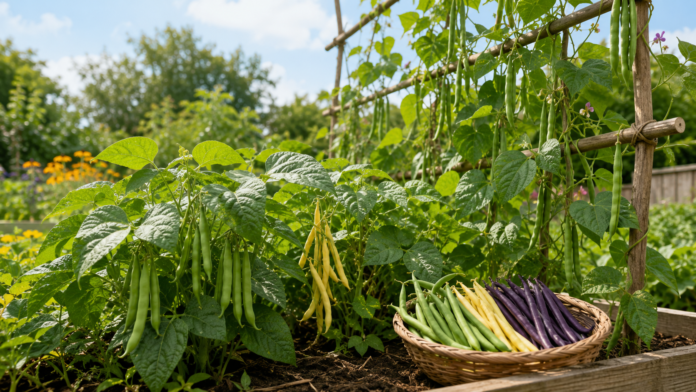
Snap beans have tender, fleshy pods with little fiber. They may be green, yellow, or purple.
Common beans include the French or European beans that produce very narrow, sometimes pencil-thin, pods. Italians prefer the thicker, flatter Romano beans. Wax beans are long and narrow with yellow pods and a waxy appearance. Purple beans such as Royal Burgundy, add color to the garden but the pods change to green when boiled. They are produced both as ornamentals and as edible vegetables.
Ornamental beans like scarlet runner beans produce striking, bright red blooms followed by beans that are edible while young. Blue hyacinth beans produce deep lilac-blue flowers which produce maroon bean pods. Ornamental beans are usually planted for their attractive flowers rather than for consumption. They grow quickly up to beautifully cover fences, trellises and arbors.